Sumner Military Heroes
Sumner High School during the 1930s had many graduates who would go on to serve in the military during World War II. These graduates would become significant barrier breakers, many of whom took on important roles during and after the War. Perhaps the most notable program that many Sumner graduates joined was the Tuskegee Air Program, an elite African American aviator program that would play a significant role in World War II. However, World War II was not without tragedy and loss for many who served in the military. The actions and deeds of those that were lost are no less inspirational than the deeds of those that returned home. The lives of these soldiers would serve as an inspiration for generations to come as they struggled both for equality and to fulfill their duty.
Master Sergeant Inman L. Perkins
Master Sergeant Inman L. Perkins was a teacher at Sumner High School with his wife Olivia M. Perkins. At the time they were together, their marriage had to remain secret so that Olivia could remain employed as a teacher. The letters between the two have been published as books by Jeffrey S. Copeland. The first book was titled Inman's War: A Soldier's Story of Life in A Colored Battalion in WWII. Perkins's Battalion, the 449th Signal Construction Battalion, landed in italy on February 20th, 1944. Master Sergeant Perkins was killed in action when lightning struck a fuel depot during the repair of communication lines. He is buried at the Sicily-Rome American Cemetery.
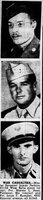
Perkins' Photograph From a Casualty List
Here is a photograph of Master Sergeant Inman L. Perkins in his military uniform. His is the top photo.
Captain Wendell Oliver Pruitt
Captain Wendell Oliver Pruitt was born on June 20th, 1920 to Elijah and Melanie Pruitt in St. Louis, Missouri. After graduating from Sumner High School, Pruitt would attend Lincoln University in Jefferson City and join the Alpha Phi Alpha faternity. Pruitt was already a liscenced pilot when enlisted to be in the U.S. Army Air Forces Cadet Flying Program in Tuskegee, Alabama. He was assigned to the 332nd Fighter Group, which was deployed to the Mediterranean in 1943, during which he piloted the P-47 Thunderbolt. He was award the Distinguished Flying Cross for the destruction of an enemy destroyer in Trieste Harbor, Italy with his wingman, 1st Leutienant Gwynne Walker Pierson. He would then pilot the P-51 Mustang after it became the 332nd's primary fighter aircraft. He would later team up with Lee Archer forming the "Gruesome Twosome", who were the most successful Tuskegee pilot pair in terms of victories. For his service he would be awarded the Distinguished Flying Cross and six Oak Leaf clusters. He was tragically killed in action in an airplane crash near Tuskegee Army Air Field during a training exercise on April 15, 1945. He was buried in St. Peter's Cemetery in Normandy, Missouri. The Pruitt-Igoe Community Housing Project was named in his honor.
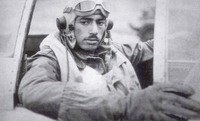
Wendell Pruitt
Here is a photograph of Captain Wendell Oliver Pruitt during his time in the military.
Lt. Colonel Clarence Shivers
Clarence Laudric Shivers was born on October 14th, 1923 to Clarence and Flossie Shivers. After graduating from Sumner High School, Shivers volunteered in the United States military in World War II. Due to his high placement on the entrance exam, he was qualified to join the Tuskegee Program. After the end of World War II, Shivers would attend Bradley University graduating as an Honor Graduate with a Bachelor Degree of Fine Arts. He would go on to teach art at Jackson State University until the Korean War where he was recalled to military service. He would retire from the Air Force in 1969 at the rank of Lieutenant Colonel. Lt. Col. Shivers and his wife, Peggy Shivers, retired to Spain where he worked as an artist full time, before eventually returning to the United States in 1979. As an artist he created numerous pieces of art that promoted the Civil Rights Movement including the calendars "Civil Rights Leaders" and "Black Political Firsts", commissioned by the Miller Brewing Company in 1983 and 1986. Another notable commission is the life-sized Tuskegee Airmen statue commissioned by the Hooks Jones Chapter of the Tuskegee Airmen in 1985. Lt. Col. Shivers and his wife established the African American Historical and Cultural Collection and the Shivers Foundation at the Pikes Peak Library District in 1993. He would pass away on February 17, 2007.
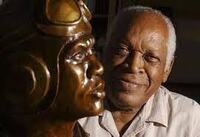
Clarence Shivers
Here is a photograph of Lt. Col. Clarence Laudric Shivers during his retirement from military service and artist career.
Charles Edward Anderson
Charles E. Anderson graduated valedictorian of his Sumner High School class. After graduating from Sumner, he would pursue higher education at Lincoln University in 1938. During his college career, he was president and then later polemarch of the Kappa Alpha Psi fraternity, he was president of his class for three years, and he co-authored the university's 75th anniversary history. After graduating from Lincoln University, he applied for the United States Army Air Corps. In July, 1942 he entered the meteorological aviation cadet program at Chicago University. In 1943, he was stationed at the Tuskegee Army Air Field, during which he would assist pilots in understanding how weather influences aviation. In 1948, after the war, the Army sent Anderson to Polytechnic University in New York, where he earned a masters degree in Polymer Chemistry. Later in the 1960s, he would continue his studies and become the first African American to earn a doctroral degree from MIT, specializing in meteorology. During the end of his career he would work as a professor for Wisconsin University and North Carolina State University. In 1966, he would become the first African American to recieve tenure at Wisconsin University. During the Civil Rights Movement, he worked to remove unfair practices from Wisconsin University, becoming their first chair of Afro-American Studies. He also was the Director of the Office of Federal Coordination in Meteorology in the Environmental Science Service for the U.S. Department of Commerce.
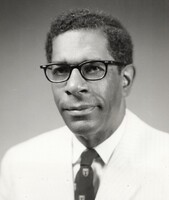
Charles Anderson
Here is a photograph of Charles E. Anderson taken in 1970, during his time as Chair of the Afro-American Studies Department