Throughout World War II the necessity of air dominance over the enemy was demonstrated time and time again. Britain and France first experienced the effects of effective air power when the German’s utilized them in their highly successful blitzkrieg tactics across Belgium, Holland and later France itself. After Britain made its miraculous evacuation from Dunkirk, it was in desperate need of bombers and training aircraft since all the factories in Britain were focused on producing fighters to defend the island nation from the Luftwaffe in the Battle of Britain. To overcome this drastic shortage, the British appealed to American factories to help replenish the lost planes. At the time, the American aircraft industry was practically stillborn due to the lingering effects of the depression. However, the industry had been revitalized thanks to orders from Britain and France starting as early as 1938 and two years later it was well on its way to being one of the first sectors of American to mobilize for war.
(Image courtesy of Missouri Historical Society, St. Louis)
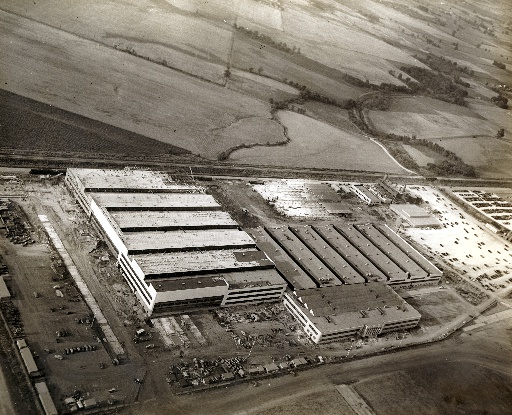
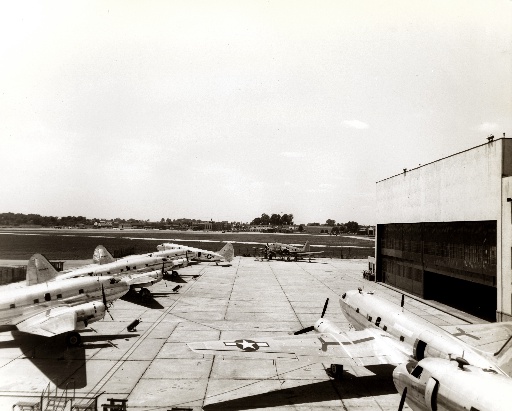
Out of all the contributions St. Louis made to the war effort, its impact on aircraft production would become one of its two most noticeable features. The city was well suited as an aircraft production center due to its temperate climate and the presence of Lambert Air field, which could be used to test experimental planes. In June of 1940, Curtiss-Wright and St. Louis Aircraft Corporation received a $16 million order for training and cargo planes. Curtiss-Wright in particular, made several significant contributions throughout the war. It was their company that designed and built the C-46 “Commando” Cargo Plane. Each aircraft was capable of transporting 40 armed men or 45,000 pounds of equipment and supplies and when the first model was completed in March of 1940, it was the largest and most technologically advanced two engine plane in the world. The plane gained notoriety in the war due to the fact that it was the only plane capable of going “over the hump” by flying over the Himalayan Mountains to bring supplies to Chinese troops fighting the Japanese. Some St. Louis firms like St. Louis Aircraft Co., Robertson Aircraft, and Laister-Kauffmann experimented with wooden glider production, with various sub-contractors making the wings and crates for the gliders to be assembled and shipped in. Unfortunately the flimsy designs of the gliders meant that few if any were ever used in combat. However, there were other ways companies like these were able to help the war effort.
(Image courtesy of Missouri Historical Society, St. Louis)
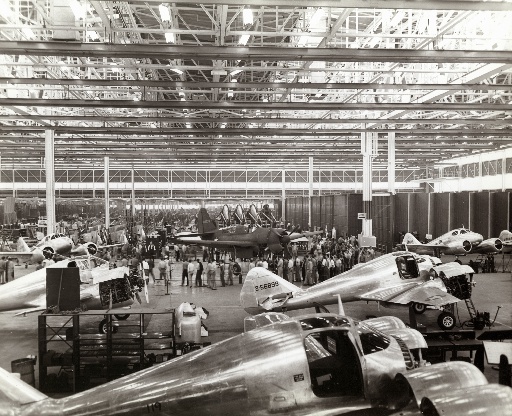
Despite the fact that the plane was designed and originally built in St. Louis, most of the C-46s produced in the war were manufactured at other divisions of Curtis-Wright across the country. There were however, other planes that the St. Louis division produced in large quantities. One was the A-25 Dive Bomber or “Helldiver” as enemy troops called it. This plane served as the army’s version of the dive bombers used by the navy. The company also manufactured scores of AT-9 twin engine trainer plane. By the end of the war, St. Louis had manufactured 900 dive bombers, 791 AT-9s, 57 “Commandos”.
(Image courtesy of Missouri Historical Society, St. Louis)
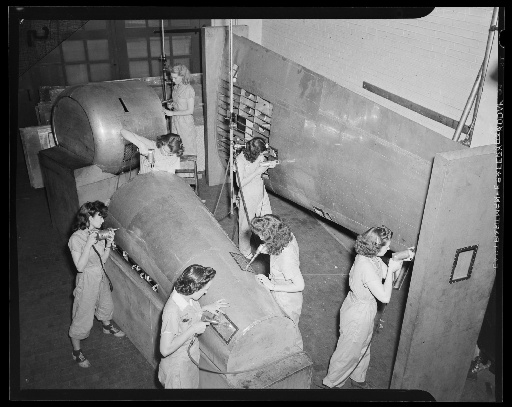
In addition to manufacturing whole planes, other aircraft companies in St. Louis were subcontracted to produce parts. The best example was the Emmerson Electric Plant, which produced electric gun turrets for the B-17 Flying Fortress and the B-24 Liberator. At the company’s peak production, six different turrets were being manufactured on six assembly lines. The company also manufactured motors for bomber and fighter controls. Alcoa Valve Company, a subsidiary of Emmerson Electric, made sheet metal for airplanes as well as different types of control systems for planes. Other companies made their own unique contribution to the war effort such the McDonnell Aircraft Company. This firm was one of twelve St. Louis subcontractors for the B-29 Superfortress. It was also the first company to design a working jet plane in the form of the FH-1 Phantom, though they weren’t mass produced until after the war. Another important innovation to come from St. Louis were the mobile repair shops for aircraft bombers that Herman Body Company designed.
(Image courtesy of Missouri Historical Society, St. Louis)
It should be noted that both Curtiss-Wright and Emmerson electric began training African Americans as well as women for skilled jobs in their plants in the summer of 1942 to offset the labor shortage that resulted from White men joining the service. Curtiss Wright even went so far as to hire all-black work shifts. The St. Louis Chamber of Commerce encouraged such practices because they believed that “discrimination limits production”. It also helped to prevent the creation of artificial labor shortages, which the city was ill equipped to handle due to the continued stream of people into the city looking for work. While these new hiring practices were an improvement for women and African Americans, many resented the change. Whites and blacks often complained or went on strike if they saw people from the other groups get promotions on the factory floor. Women also encountered resentment from male workers, thus disproving the patriotic image of “Rosie the Riveter”
